Cooling a large space in the UAE is a bigger decision than it first looks. A warehouse with open dock doors, a workshop full of hot machinery and a sealed production hall all behave differently, and no single system suits all three. Evaporative air coolers cost less to run on paper, while refrigerated air conditioning holds a set temperature in any weather. The right answer depends on humidity, airflow, water supply and how the space is used. This guide compares both options on energy, installation cost and upkeep, and shows what to ask an industrial air cooler manufacturer before you commit to either.
What “Industrial Air Cooler” Means
The term covers two quite different machines, and mixing them up is a common source of bad specifications.
- Evaporative air cooler: Draws air through a wetted pad. Water evaporates, the air cools and a steady supply of fresh air enters the space. This is the machine most buyers mean when they compare “air coolers” with AC.
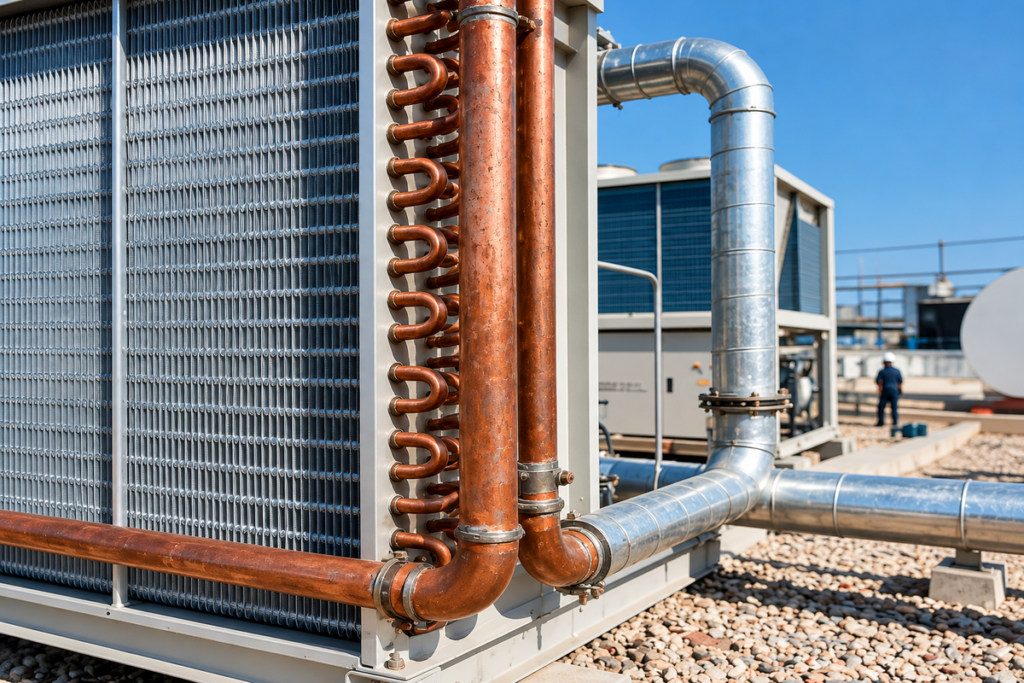
- Air-cooled heat exchanger: A finned unit that moves heat from a liquid or refrigerant into the surrounding air. Viking’s aluminium air coolers belong to this group. They are dry, with no water spray or evaporation, and they cool fluids, not rooms.
How Each System Cools
| Feature | Evaporative air cooler | Traditional (refrigerated) AC |
| Cooling method | Water evaporating into airflow | Refrigerant cycle removes heat from the air |
| Air supply | Constant fresh air in, warm air out | Recirculates the same air |
| Effect on humidity | Adds moisture | Removes moisture |
| Water use | Continuous | Minimal for most split and packaged units |
| Best conditions | Low humidity | Any climate |
| Sealed building | Poor fit, needs an exhaust path | Good fit |
What the Energy Figures Say
The US Department of Energy states that evaporative coolers use about one-quarter as much energy as central air conditioners and cost about half as much to install. Those are headline figures for residential equipment. Industrial results will vary with fan size, duty hours and airflow, so treat them as the direction of travel, not a quotation.
The same source gives the limits. Evaporative coolers are only suitable for areas with low humidity, and they should not be used in humid climates because they add moisture to the air. They also use water continuously, which can matter where supply is limited.
Why UAE Humidity Decides the Outcome
Evaporative cooling works because dry air can absorb water vapour. When the air is already moist, less water evaporates and the cooling effect shrinks. Many UAE sites combine summer heat with high humidity, particularly on the coast, so the same cooler can perform very differently in an inland yard and a port-side warehouse.
Before you specify anything, ask for:
- Hourly dry-bulb and wet-bulb temperature data for your location, from the UAE’s National Centre of Meteorology or your own site records.
- The supply air temperature the cooler can reach at your worst summer wet-bulb condition.
- The humidity your process, stock or workforce can tolerate.
A good industrial air cooler manufacturer should work from these numbers, not from a generic capacity rating.
Large Spaces Change the Maths
Size and layout matter as much as the machine:
- Open or semi-open buildings: Loading bays, workshops and yards suit evaporative cooling, because the extra air has somewhere to go.
- Sealed or conditioned spaces: Clean rooms, server rooms and temperature-controlled stores need refrigerated cooling to hold temperature and humidity.
- Heat sources inside: Furnaces, compressors and engines load the space, and air movement over workers may matter more than the air temperature.
- Ventilation: The Department of Energy advises leaving openings so warm indoor air can escape, because too little opening lets humidity build up. A large hall needs an exhaust plan, not just more coolers.
A Fair Cost Comparison
Compare total cost, not the purchase price alone. Gather these items for each option:
| Cost item | What to collect |
| Equipment and installation | Written quotes covering ducting, pads, pumps and controls |
| Electricity | Fan and compressor loads, running hours, your tariff |
| Water | Make-up water per hour, supply cost, any treatment |
| Maintenance | Pad and filter replacement, pump servicing, refrigerant checks |
| Ventilation works | Louvres, extract fans or doors that must stay open |
| Productivity and stock risk | Temperature and humidity limits in the space |
For maintenance, the Department of Energy says evaporative coolers need more frequent attention than refrigerated air conditioners. In hot climates it advises checking the pads, filters, reservoir and pump at least once a month, with a major clean each season. Budget for that routine from day one.
Common Specification Mistakes
Most disappointing installations trace back to a few avoidable errors:
- Sizing on dry-bulb temperature alone. The wet-bulb figure sets how far an evaporative unit can cool the air.
- Ignoring the exhaust path. Without somewhere for air to leave, humidity builds and comfort falls.
- Counting only purchase price. Water, pad replacement and ventilation works change the total.
- Cooling the whole volume. In a tall hall, cooling the working zone is often enough.
- Skipping a pilot. One unit on your hardest summer shift tells you more than a brochure.
- Forgetting maintenance staff. A monthly check only happens if someone owns it.
Where the Components Sit Behind Both Options
Traditional air conditioning depends on coils and heat exchangers, and their quality affects energy use over the life of the system. Viking Emirates Radiators and Cooling Industry in Sharjah manufactures AHU coils, chiller coils, condenser coils and evaporative condenser coils, along with coolers and heat exchangers. For plant rooms, generators and compressors that sit beside the cooled space, its Industrial Radiators are built to match your equipment. Viking’s pages describe a local Sharjah facility, in-house manufacturing and inspection of every unit before it leaves.
Note that Viking’s site does not list evaporative room coolers as a product. Ask any industrial air cooler manufacturer, Viking included, exactly what it makes and what it sources.
Questions to Ask Before You Buy
- What cooler type and airflow do you recommend at my worst wet-bulb temperature?
- What supply air temperature will the unit deliver on a peak summer day?
- How much water does each unit use per hour?
- What exhaust or ventilation do you need on site?
- Which pads, pumps and motors are replaceable, and are spares held locally?
- Can you supply coils or heat exchangers for the AC or chiller side as well?
- What inspection and testing does each unit pass before delivery?
Conclusion
Evaporative air coolers and traditional AC are not rivals so much as tools for different spaces, and the right industrial air cooler manufacturer will say so. Coolers can cost far less to install and run in dry, ventilated spaces, while AC is the safer choice where humidity and temperature must be controlled. Gather your own climate data, collect all the cost items and check ventilation before you decide. Viking Radiators manufactures radiators, coils, coolers and heat exchangers in the UAE. Contact us to talk through your site, your cooling load and the components your system needs.