
Industrial cooling in the Gulf has to deal with a problem most equipment designers elsewhere never face: ambient temperatures that regularly climb past 45°C for months at a time, combined with dust loading and humidity swings that push conventional cooling systems to their limits. Heat pipes offer a way around part of that problem, moving large amounts of heat with no pump, no compressor, and no moving parts to fail under sustained thermal stress.
For plant engineers and facility managers across the UAE and KSA, understanding how this technology actually works, and where it genuinely improves on active cooling makes procurement decisions considerably easier. This article breaks down the mechanics of passive thermal transfer, where heat pipes outperform conventional coils, and what to check before sourcing them. Working with an established heat pipes manufacturer in the UAE also means the design gets matched to your specific operating conditions rather than sold as an off-the-shelf part.
What a Heat Pipe Actually Is
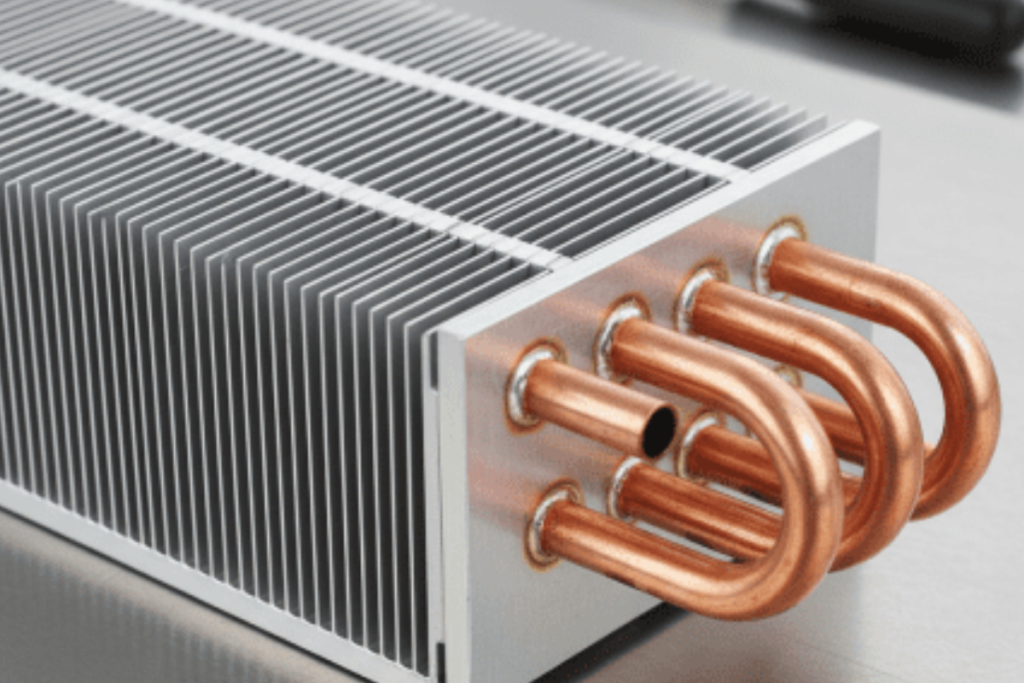
A heat pipe is a sealed, evacuated tube containing a small amount of working fluid and, in most designs, an internal wick structure. This basic design is what any heat pipes manufacturer in the UAE works from before adapting it to a specific application, and it has three functional zones:
- Evaporator: the section in contact with the heat source, where the working fluid absorbs heat and vaporises
- Adiabatic section: the middle length of the pipe, where vapour travels with minimal heat loss
- Condenser: the cooler end, where vapour releases its heat and condenses back to liquid
The condensed liquid then returns to the evaporator, either by gravity or capillary action through the wick, and the cycle repeats continuously as long as a temperature difference exists between the two ends.
How Passive Thermal Transfer Works, Step by Step
- Heat from the source is absorbed at the evaporator, causing the working fluid to vaporise.
- The resulting pressure gradient pushes vapour through the adiabatic section toward the cooler condenser end.
- At the condenser the vapour releases its latent heat to the surrounding heat sink and condenses back into liquid.
- The liquid returns to the evaporator via gravity or wick-driven capillary action, ready to repeat the cycle.
Because this entire process relies on phase change rather than mechanical circulation, a heat pipe can move far more heat for a given temperature difference than a solid metal conductor of the same size, and it does so with no ongoing energy input.
Why It Matters More in Gulf Climates
| Regional Condition | Effect on Cooling Systems | How Heat Pipes Help |
| Sustained high ambient temperatures | Reduced compressor and fan efficiency, higher failure rates | No moving parts, so performance doesn’t degrade under continuous thermal load |
| Airborne dust and sand | Fouling of moving components, blocked filters | Sealed construction with no exposed mechanical parts to clog |
| High humidity in coastal cities | Increased latent cooling load, condensation issues | Heat pipe wrap-around coils pre-cool and reheat air to improve dehumidification without extra compressor capacity |
| Power reliability variance | Active systems fail when power is interrupted | Fully passive operation continues regardless of electrical supply |
This is precisely why demand for a dependable heat pipes manufacturer in the UAE has grown steadily across HVAC, data centre, and industrial cooling projects, the region’s operating conditions expose weaknesses in active-only cooling systems faster than they would in milder climates.
Heat Pipes vs Conventional Cooling Coils
| Factor | Heat Pipe System | Conventional Active Cooling |
| Moving parts | None | Pumps, fans, compressors |
| Energy input required | None for the transfer itself | Continuous |
| Maintenance profile | Low, sealed unit | Higher, filters, bearings, seals |
| Noise | Silent | Fan and compressor noise |
| Best suited for | Dehumidification, waste heat recovery, spot cooling | Full-load primary cooling |
Heat pipes rarely replace a chiller or AHU outright; they’re most effective when paired with existing systems to reduce load, recover waste heat, or improve dehumidification performance. Most engineers working with a heat pipes manufacturer in the UAE treat the technology this way, as a complement to active cooling rather than a wholesale replacement for it.
Common Industrial Applications Across the UAE and KSA
A capable heat pipes manufacturer in the UAE typically sees demand concentrated across a handful of recurring use cases:
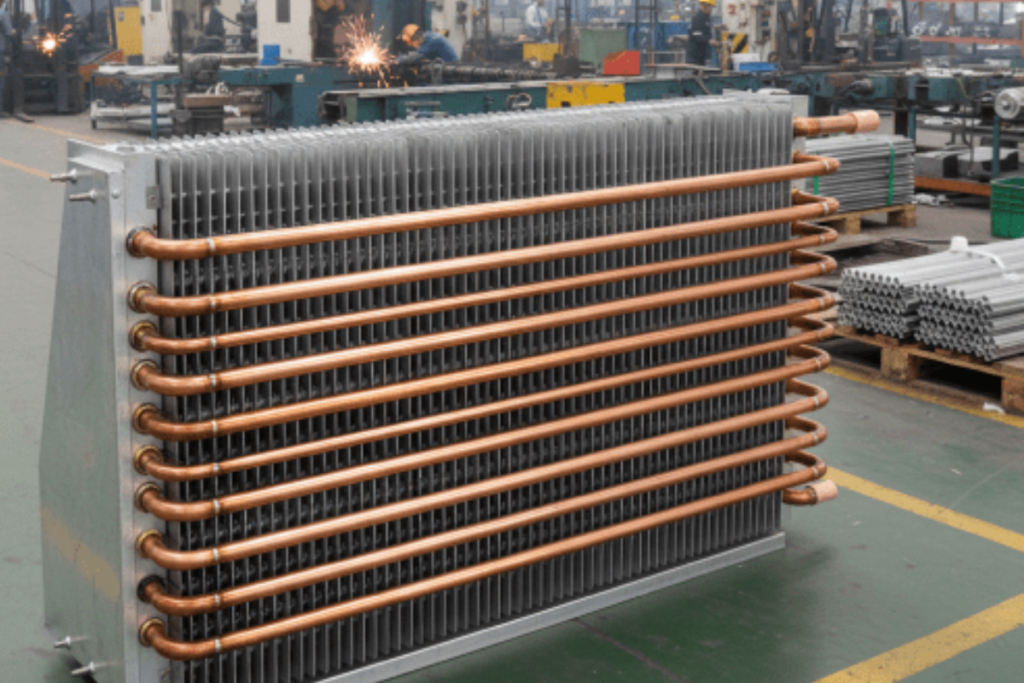
- Commercial HVAC dehumidification: wrap-around heat pipe coils pre-cool and reheat supply air around a standard cooling coil, cutting the compressor work needed to control humidity
- Data centre cooling: passive heat rejection reduces reliance on mechanical cooling for non-critical loads
- Oil and gas facilities: heat recovery from process streams where mechanical circulation isn’t practical
- Power generation: waste heat recovery from flue gas and process exhaust
- Electronics and control panel cooling: compact heat pipes manage localised hot spots in enclosures exposed to high ambient heat
What to Check Before Sourcing Heat Pipes
Not every heat pipe design suits every application, so a few specification checks matter before placing an order:
- Working fluid compatibility with your operating temperature range, water-based heat pipes suit most HVAC and moderate-temperature industrial use, while other fluids are needed for very high or cryogenic applications
- Wick structure appropriate to orientation, gravity-assisted designs work differently from capillary wick designs when the pipe isn’t mounted vertically
- Material compatibility between the tube, working fluid, and the surrounding environment, particularly in coastal or high-humidity sites
- Manufacturing traceability, including material certificates and pressure testing records
An experienced heat pipes manufacturer in the UAE will walk through these variables against your specific heat load and site conditions rather than supplying a generic catalogue part.
Conclusion
Heat pipes solve a specific but genuinely common problem in Gulf industrial cooling: how to move heat reliably without adding another mechanical component that has to survive extreme ambient conditions. Getting the design right depends on matching the working fluid, wick structure, and orientation to your actual site conditions, which is where sourcing from a manufacturer with regional experience makes the difference over a generic import. Viking Emirates Radiators has manufactured thermal management equipment for UAE industries since the early 1990s, and our team can assess your application and recommend the right heat pipe configuration for your equipment. Contact us at +971 55 654 9544 to discuss your project requirements.